Quick answer
Every Sunrise Hauling Co. dump-trailer rental includes a weight allowance of 1, 1.5 or 2 tons for the 10, 15 and 20-yard sizes, where a ton is 2,000 lb. Weight over the allowance is billed at $99 per ton. Shingles, concrete, brick, tile, dirt and soaked yard waste use up that allowance long before a trailer looks full.
How included weight works
Every rental has two limits: space and weight. Space is the trailer size you pick. Weight is the allowance that comes with it:
- 10-yard ($300 for 3 days): 1-ton allowance
- 15-yard ($350 for 3 days): 1.5-ton allowance
- 20-yard ($400 for 3 days): 2-ton allowance
The allowance is the same whether you keep the trailer one day or 14 days. After we haul the trailer away, the load is weighed on the disposal facility's scale, and that scale weight is what counts. If the load comes in over the allowance, the difference is billed at $99 per ton. If it comes in under, there's no weight charge at all. Weight and time are separate: each day after the first adds $75, no matter what the load weighs.
What counts as a ton
A ton here is the US ton of 2,000 lb, not the metric tonne of 1,000 kilograms (about 2,205 lb) that many people picture. For example, 1.5 tons is 3,000 lb and 2 tons is 4,000 lb.
Most household and remodel debris is lighter than people expect. The EPA's standard conversion factors put mixed construction and demolition debris at 417 to 484 lb per cubic yard (U.S. EPA (opens in a new tab)), so a trailer of drywall, trim, cabinets and packaging usually fills up before it gets heavy. Dense materials are a different story.
What heavy materials weigh
These planning figures come from manufacturer data sheets and government conversion tables. Real loads vary with moisture, how tightly things pack and what's stuck to them, so treat them as estimates, not guarantees.
Asphalt shingles, per roofing square
A roofing square is 100 square feet of roof. CertainTeed's own data sheets list these approximate weights per square for new shingles:
- 3-tab (XT 25): 190–203 lb per square (data sheet (opens in a new tab))
- Architectural (Landmark PRO): 231–240 lb per square (data sheet (opens in a new tab))
- Heavy designer (Grand Manor): about 425 lb per square (data sheet (opens in a new tab))
A tear-off also brings underlayment, nails and flashing, and an older roof may hide a second layer, so treat the shingle weight as the floor, not the total. Rule of thumb: one ton covers roughly 8 to 10 squares of standard shingles, or fewer than 5 squares of heavy designer shingles.
Concrete
The Iowa Department of Transportation puts normal-weight concrete at 140 to 150 lb per cubic foot (Iowa DOT (opens in a new tab)). That works out to:
- About 3,780–4,050 lb per cubic yard of solid concrete
- About 47–50 lb per square foot of a 4-inch slab
- About 4,700–5,000 lb for a 10-by-10-foot patio slab, 4 inches thick
Breaking it up doesn't make it lighter: the same slab in pieces takes more room but weighs exactly as much. Seattle Public Utilities' conversion table lists broken concrete at 2,850 lb per cubic yard (Seattle Public Utilities (opens in a new tab)).
Brick
Glen-Gery, a brick manufacturer, lists a standard modular brick at about 1.8 kg, roughly 4 lb (Glen-Gery (opens in a new tab)). The Brick Industry Association counts 675 modular bricks per 100 square feet of wall (Brick Industry Association (opens in a new tab)). So 100 square feet of single-layer brick, such as a planter wall or a section of veneer, comes to about 2,700 lb before you count the mortar.
Tile
Seattle's table lists loose 6-by-6-inch ceramic tile at 1,200 lb per cubic yard. Tile rarely comes up clean: thinset, mortar beds and cement backer board come out with it, and all of it is heavy. Two cubic yards of tile debris is already more than a ton.
Dirt and sand
Seattle lists dry soil at 2,025 lb per cubic yard, so every cubic yard is about a ton, and wet soil weighs more because of the water it holds. A trailer filled with dirt would carry several times any of our allowances, which is why we ask you to call before loading dirt, sand or sod.
Wet yard waste
Dry yard waste is light: Seattle lists yard trimmings at about 350 lb per cubic yard, and the EPA's factors put loose mixed yard waste at about 250. Grass clippings are listed at 400 to 1,500 lb per cubic yard, a wide range that tracks how wet and packed they are. Soaked leaves, fresh grass, sod and wet mulch can multiply a load's weight, and our summer afternoon storms soak an open trailer fast.
How to avoid overage
- Tell us what you're loading. Heavy material is allowed but adds weight fast, so ask before you load concrete, brick, tile, dirt or shingles, and we'll help you choose a size.
- Do the math first. Squares times weight per square for a roof, square feet times about 50 lb for a 4-inch slab, cubic yards times about 2,025 lb for soil.
- Spread heavy debris out. Lay it evenly across the trailer floor instead of piling it at one end.
- Stay level with the walls. Never load above the top of the trailer walls.
- Cover it before rain. A tarp keeps storm water out of carpet, drywall, mattresses and yard waste, which all soak it up.
- Keep prohibited items out. Our guide to what can't go in a dumpster has the list.
Planning a roofing job
Roofing is where the weight math matters most. Plan it in four steps:
- Find the roof area in squares: total square feet of roof divided by 100.
- Multiply by the weight per square on your shingle's data sheet, or use the ranges above.
- Add a margin for underlayment and nails, and double the shingle weight if there's a second layer.
- Compare the total with the allowance on the size you're considering; anything over is $99 per ton.
Here's how that plays out. A 20-square roof of architectural shingles at 231–240 lb per square is about 4,620–4,800 lb, or 2.3 to 2.4 tons, of shingles alone. By volume that's only about 9 to 10 cubic yards (Seattle's table lists composition shingles at 500 lb per cubic yard), so the load would leave a 20-yard trailer roughly half empty while its weight is measured against the 2-ton allowance. On roofing jobs, weight runs out before space does.
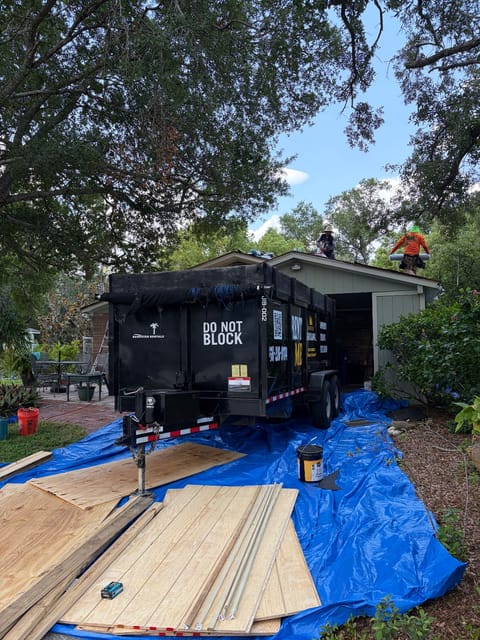
Our roofing dumpster rental page covers trailer placement during a tear-off, including the protective boards we set under the trailer. Roofers who rent regularly can request contractor pricing for repeat-customer rates and priority scheduling.
Remodel and construction debris
Mixed remodel debris is mostly a space question. The EPA's factors list gypsum board at 467 lb per cubic yard and clean dimensional lumber at 169, which is why a trailer of drywall, studs and cabinets usually fills before it reaches its allowance. Tile, plaster, masonry and concrete change that quickly. If you're running an active job site, our construction dumpster rental page explains what fits and how to book a trailer for the site.
Sources
- CertainTeed — XT 25 shingles technical data sheet (05/21) (opens in a new tab)
- CertainTeed — Landmark PRO shingles technical data sheet (10/23) (opens in a new tab)
- CertainTeed — Grand Manor shingles technical data sheet (02/20) (opens in a new tab)
- Iowa DOT — IM 340, weight per cubic foot of concrete (opens in a new tab)
- Seattle Public Utilities — Volume and weight conversion factors (Dec 2022) (opens in a new tab)
- Glen-Gery — Extruded brick product profile (rev. 1/2019) (opens in a new tab)
- Brick Industry Association — Technical Note 10, Dimensioning and estimating brick masonry (opens in a new tab)
- U.S. EPA — Volume-to-weight conversion factors (April 2016) (opens in a new tab)