Quick answer
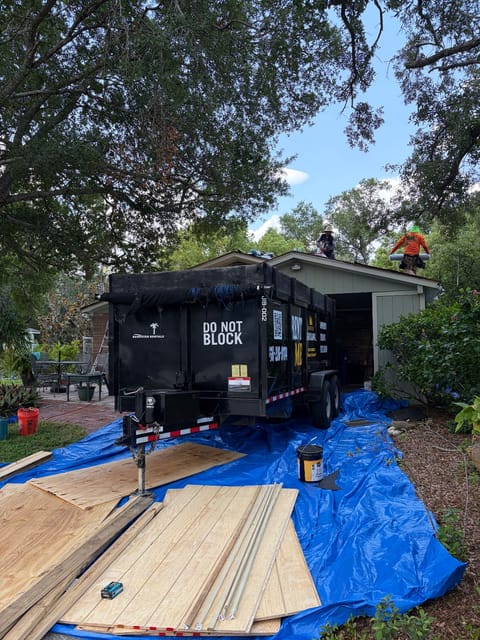
Pick a flat, firm, paved spot, usually your driveway, with room for our truck to back in and nothing low overhead. Move cars, unlock gates and check your HOA rules before delivery, and keep the trailer off lawns, septic areas and the street unless your city allows it. We set protective boards under the trailer's contact points to help prevent marks.
Start with the spot
The best spot for a dump trailer is a flat, firm, paved surface (usually your driveway) close to where the debris is coming from, with room for our truck to back in straight. Before delivery day, walk the space and check four things.
- Width and approach: the truck and trailer need a clear path in, so move cars, bikes and trash carts. Ask us for exact trailer dimensions before you book.
- Overhead clearance: note anything low over the drive, such as branches, power or cable lines, gutter edges or a basketball hoop.
- What's underneath: sprinkler heads, irrigation lines, septic tanks and drainfields. Florida's Department of Environmental Protection tells septic owners to keep vehicles from driving or parking over the tank or drainfield (FDEP septic owner's guide (opens in a new tab)), and that includes a truck and a loaded trailer.
- Distance to the work: the closer the trailer sits to the garage, back gate or room you're tearing out, the fewer wheelbarrow trips you make. Leave a walking path to your front door and garage.
Slope, surface and soft ground
A level, paved spot is what you want. If your driveway slopes, is gravel or dirt, or the only open area is grass, tell us when you request the rental so we can talk through options before the truck shows up. Placing a trailer on a lawn is at your own risk, because grass and sandy soil soften after heavy rain and wheels can rut them. If we arrive and can't place or retrieve the trailer safely, we'll set another day with you rather than force it.
How we protect your driveway
We set protective boards under the trailer's contact points to help prevent marks on concrete and pavers, and our trailers are driveway-friendly. The boards help, but they aren't a guarantee, so point out anything fragile before we place the trailer:
- newly poured concrete that's still curing
- cracked or settling slabs
- loose or recently laid pavers
- decorative coatings or stamped finishes
HOA and deed-restricted communities
Check your community's rules before delivery, because many Tampa Bay neighborhoods have them. The Westchase Community Association, for example, is described as the largest deed-restricted community in the area, organized into 28 villages with elected voting members (Westchase (opens in a new tab)), and FishHawk Ranch covers more than 3,000 acres of distinct villages within a Community Development District (FishHawk (opens in a new tab)). Rules differ from one community to the next, so look for:
- whether temporary containers or trailers are allowed at all, and for how long
- whether they must sit on the driveway rather than the street
- notice or written approval from the management company or board
- gate codes and delivery-window limits in gated sections
Getting HOA approval is the renter's job (we don't obtain permits or approvals for you), and if a property manager requires a certificate of insurance, we can provide one. You choose the rental length when you book, from one day to 14 days, so book only the days your HOA allows; if you need more later, text us and we'll add days at $75 each when the trailer is free.
Street and right-of-way placement
Keep the trailer on private property whenever you can. Rules for placing a trailer in a street, swale or other public right-of-way vary by city and county, and as of October 2026 we haven't found a published rule we can quote for every city we serve. Call your city or county before planning a street spot, and check with your HOA too, since many restrict street parking. If a street spot is approved:
- don't block sidewalks, mailboxes, storm drains or fire hydrants
- leave neighbors' driveways and sight lines clear
- keep the area around it swept, because loose debris in the road is the renter's responsibility
Loading tips: heavy first, level, never over the top
How you load affects how safely the trailer tows and how much you pay.
- Heaviest items first. Put dense material on the floor, toward the front (the hitch end), spread from side to side. Don't pile it all at the back or along one side.
- Load evenly. Build the load in layers rather than one tall heap, so the weight stays balanced.
- Break things down. Take the legs off tables, flatten boxes and cut long boards, then fill the gaps with smaller pieces.
- Stop at the rails. Nothing goes above the top of the side rails; we can't haul an overloaded trailer until it's brought back under the rail line.
- Watch dense debris. We take concrete, brick, tile, dirt and shingles, but they use up the included 1, 1.5 or 2 tons (by size) long before the trailer looks full, and each ton over is $99; see dumpster weight limits.
- Keep prohibited items out. Paint, chemicals, tanks and the rest are covered in what can't go in a dumpster.
Anything a neighbor or passer-by tosses in becomes part of your load and your weight, so keep an eye on it.
Planning around Florida rain
Rain is the variable most people forget. The Southwest Florida Water Management District says the region's rainy season runs June through September and brings about 60% of the average annual rainfall (SWFWMD (opens in a new tab)), and water adds weight.
- Mattresses, carpet, upholstery, drywall and cardboard soak up rain and get heavier.
- A tarp over the load during an afternoon storm keeps soft items dry.
- If storms are coming, load absorbent items last, or keep them in the garage until you're ready.
- If a tropical storm is in the forecast, call us about moving your pickup date; our scheduling is flexible.
Your delivery-day checklist
- cars, trash carts and boats moved out of the way
- gates unlocked and pets inside
- sprinkler heads and septic lids flagged
- low branches or wires pointed out to the driver
- HOA approval in hand, if your community needs it
Then pick the size that fits the job: the 10-yard for smaller cleanouts, the 15-yard for remodels and bigger cleanouts, or the 20-yard for the largest jobs. Book your dates online in a couple of minutes; the trailer is held right away, and we text to confirm the delivery window and the spot.